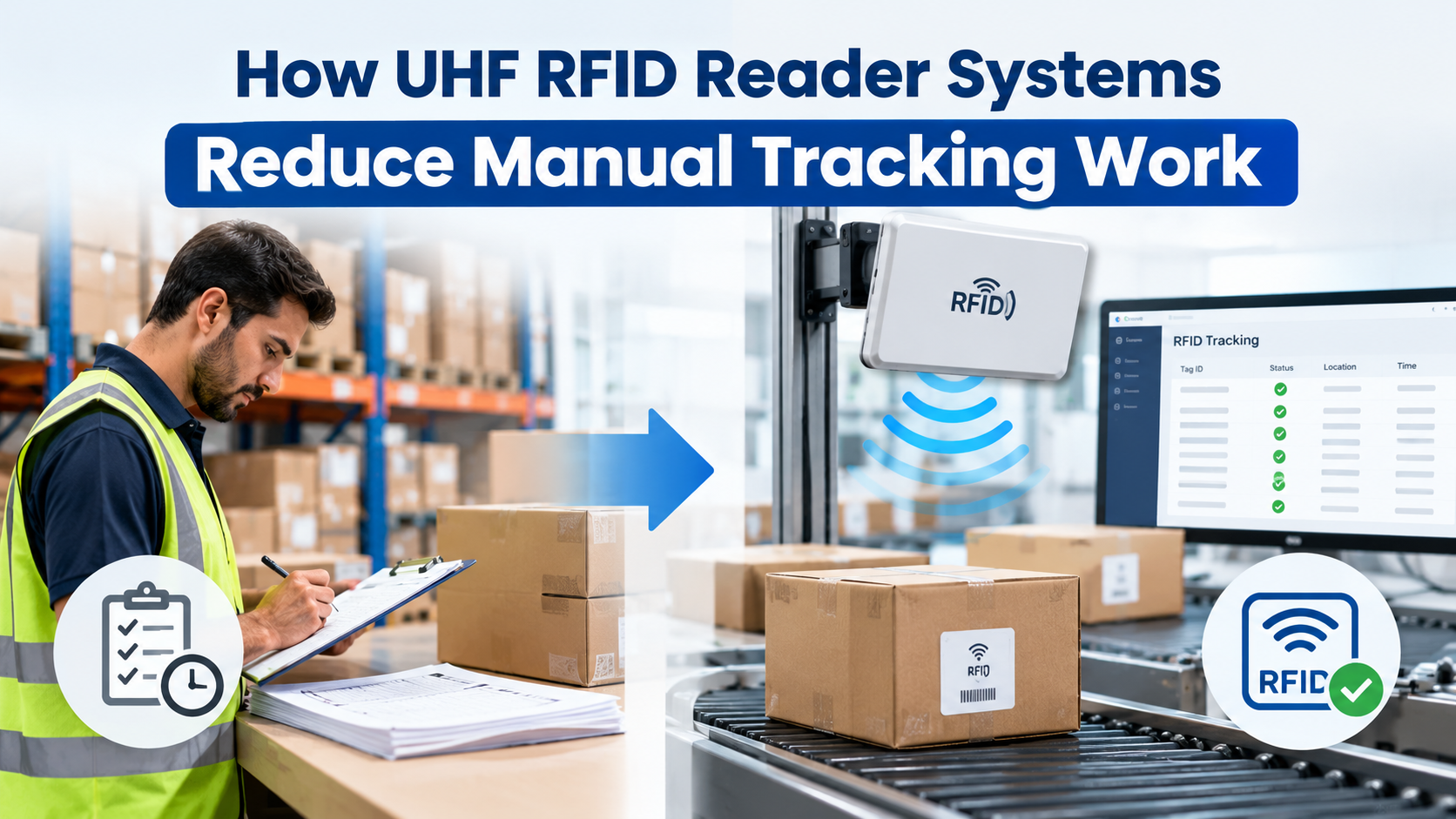
How UHF RFID Reader Systems Reduce Manual Tracking Work
Businesses that manage inventory, equipment, products, and other physical assets often spend a significant amount of time tracking items manually. Employees may need to scan barcodes individually, enter product details into spreadsheets, update inventory records, and verify stock levels. These activities can increase workloads, slow down daily operations, and create opportunities for human error. As businesses grow, managing these tasks manually becomes more challenging.
Radio Frequency Identification (RFID) technology offers a practical way to simplify identification and tracking processes. Ultra-High Frequency (UHF) RFID systems use radio waves to identify tagged items without requiring direct visual contact between the reader and the tag. This capability allows businesses to collect information from multiple tagged items within a suitable reading area, reducing the need for repeated manual scanning.
What Is a UHF RFID Reader System?
A UHF RFID system is an identification and tracking solution that uses radio frequency signals to read information stored on RFID tags. It generally consists of RFID tags, a reader, one or more antennas, and software that processes the collected information.
The tags are attached to products, cartons, equipment, pallets, or other assets. When a tagged item enters the reader's detection area, the reader communicates with the tag and collects its identification data. The connected software can then use this information to update inventory records, track movements, or support other business processes.
A UHF RFID reader is particularly useful in applications where businesses need to identify numerous items quickly. Unlike traditional barcode systems, RFID technology does not always require employees to position each label directly in front of a scanner. This can make routine identification tasks more efficient when the system is properly configured.
1. Reduces Repeated Manual Data Entry
Manual tracking frequently involves writing down product information, entering identification numbers, and updating spreadsheets or inventory management systems. Every additional step takes time and increases the possibility of typing mistakes, duplicate entries, or incomplete records.
RFID systems automate much of this information collection. When tagged items pass through an appropriate reading area, the reader captures their identification data and transfers it to connected software. Depending on the integration, the software can update records automatically or send the information for verification.
For example, a warehouse employee receiving a shipment may otherwise need to scan individual barcodes and enter quantities into a system. With a properly configured RFID setup, multiple tagged items can be identified in a single reading process, reducing repetitive data entry.
2. Makes Inventory Counting Faster
Regular inventory counting is important for maintaining accurate stock records. However, manually checking every product can require considerable time, particularly in large warehouses, distribution centres, and manufacturing facilities.
UHF RFID technology can simplify this process by identifying several tagged products within the reader's effective range. Employees may be able to conduct inventory checks without handling every item individually, depending on the placement of tags, reader performance, and the surrounding environment.
Faster inventory counting allows staff to spend less time on repetitive verification and more time on activities such as replenishment, order preparation, and stock planning.
Businesses should still establish suitable counting procedures and investigate discrepancies rather than assuming every RFID reading represents a complete inventory record.
3. Improves Tracking Across Warehouses and Storage Areas
Keeping track of products as they move between receiving areas, storage locations, packing stations, and dispatch zones can be difficult when records depend entirely on manual updates.
RFID readers installed at suitable locations can automatically identify tagged items as they pass through defined checkpoints. The collected information can help businesses record product movement and improve visibility across different stages of warehouse operations.
For instance, a distribution centre may use RFID technology to identify cartons moving from a receiving dock to a storage area. When integrated with warehouse management software, these readings can help employees determine where items were last detected.
This approach reduces dependence on manual movement logs and can make it easier to investigate misplaced inventory.
4. Minimises Human Errors in Tracking Records
Manual tracking depends on employees entering correct information and following consistent procedures. Errors can occur when product codes are mistyped, labels are overlooked, quantities are recorded incorrectly, or records are not updated on time.
Automated RFID data collection can reduce several of these risks by capturing identification information directly from tags. It also helps businesses establish consistent procedures for recording item movements and inventory transactions.
However, RFID does not eliminate every type of error. Damaged tags, unsuitable antenna placement, radio interference, or incorrect software configuration may result in missed or duplicate readings. Regular system testing and exception handling remain essential for dependable results.
5. Supports Faster Receiving and Dispatch Operations
Receiving and dispatch activities often involve checking product quantities, verifying shipment contents, and matching physical goods against digital records. These checks can become time-consuming when shipments contain many individual items.
An RFID-enabled receiving or dispatch station can identify tagged goods within its reading zone. The system can compare the captured information with expected shipment records and help employees identify potential discrepancies.
For example, if a business prepares a shipment containing multiple tagged cartons, RFID readings may help verify which items have passed through the dispatch checkpoint. This can reduce repetitive scanning and support more organised shipment handling.
The effectiveness of this approach depends on tag readability, the movement of goods, the reading environment, and the accuracy of the connected software.
6. Helps Businesses Monitor Equipment and Fixed Assets
Many organisations manage tools, computers, machines, containers, and other reusable assets across multiple departments or locations. Without a reliable tracking process, employees may spend considerable time searching for equipment or confirming who last handled it.
RFID tags can provide each asset with a unique identification reference. Readers placed at selected checkpoints can record when tagged equipment is detected, helping organisations maintain better asset movement records.
For example, a manufacturing facility may use RFID to monitor reusable containers moving between production and storage areas. Similarly, a business may use RFID-supported inventory checks to identify equipment that requires verification.
These systems are most useful when businesses maintain accurate asset records and define clear procedures for updating ownership, location, and maintenance information.
7. Integrates with Digital Inventory and Business Software
RFID technology becomes more valuable when it works alongside existing business systems. Readers can send collected information to suitable applications through supported interfaces, allowing organisations to connect identification activities with inventory management, warehouse management, enterprise resource planning, or asset tracking software.
Such integration can help businesses reduce duplicate data entry and create more consistent records across departments.
For example, an RFID reading at a receiving station may initiate an inventory update after the system validates the relevant transaction. A reading at a dispatch point may help update shipment status when the appropriate business rules are satisfied.
Before implementation, businesses should confirm software compatibility, integration requirements, data security, and the procedures used to handle incomplete or unexpected readings.
8. Improves Employee Productivity and Operational Planning
Manual tracking can divert employees from tasks that require judgement, coordination, and problem-solving. When routine identification becomes more automated, staff may spend less time scanning products individually and maintaining repetitive records.
Managers can also use collected data to understand item movement, identify recurring delays, and review inventory processes. These insights may support better resource planning and more informed operational decisions.
Businesses should evaluate productivity improvements using practical measurements, such as inventory counting time, order verification time, data entry errors, and the frequency of missing-item investigations.
The goal is not simply to introduce new equipment but to make daily workflows more efficient and reliable.
Choosing the Right UHF RFID System for Your Business
Selecting an appropriate RFID solution requires an understanding of the items being tracked and the environment in which the system will operate. Businesses should consider several factors before investing.
- Reading range: Determine the distance required for identifying tagged products or assets in the intended application.
- Tag compatibility: Check that the reader supports the RFID tags and frequency standards used by the business.
- Antenna configuration: Select suitable antennas and positioning for the size and layout of the reading area.
- Operating environment: Consider metal surfaces, liquids, packaging materials, nearby equipment, and possible radio interference.
- Software integration: Confirm compatibility with existing inventory, warehouse, or asset management applications.
- Installation and support: Evaluate configuration assistance, testing, maintenance, and technical support.
Organisations looking for a UHF RFID reader dealer in Jaipur should compare product compatibility, application experience, installation support, and after-sales service rather than selecting equipment based on price alone.
Businesses exploring wider identification and access-related technologies may also evaluate an Electronic Security Solutions manufracturer based on its product range, integration capabilities, and suitability for their operational requirements. Correct product selection and professional configuration can help create a more dependable system.
Common Applications of UHF RFID Reader Systems
UHF RFID readers can support tracking requirements across a variety of industries.
Warehousing and logistics: Businesses can identify tagged cartons, pallets, and shipments at selected checkpoints.
Retail: Retailers can improve stock visibility and simplify inventory checks across storage areas and sales floors.
Manufacturing: Production facilities can track work-in-progress items, reusable containers, and selected equipment.
Healthcare: Hospitals may use RFID systems to track tagged assets, equipment, and supplies, subject to appropriate operational and privacy controls.
Libraries and document management: Suitable RFID implementations can help identify tagged books, files, and other physical records.
The specific benefits depend on the tracking objective, the design of the RFID system, and how accurately the collected data is integrated into daily operations.
Conclusion
UHF RFID reader systems can reduce manual tracking work by automating item identification, simplifying inventory counting, improving movement records, and reducing repetitive data entry. They can also support faster receiving and dispatch activities while helping businesses maintain better visibility of products and assets.
Successful implementation requires more than installing a reader. Businesses should select compatible tags, configure antennas correctly, integrate the system with suitable software, and establish procedures for handling missed readings and inventory discrepancies.
With careful planning, UHF RFID technology can help organisations build more efficient tracking processes, improve record accuracy, and make better use of employee time as operational requirements grow.
FAQs
1. What is a UHF RFID reader used for?
A UHF RFID reader is used to identify and track tagged products, inventory, equipment, and assets using radio frequency signals without requiring direct visual contact.
2. How do UHF RFID reader systems reduce manual tracking work?
These systems automate item identification, inventory counting, and movement recording, reducing repetitive barcode scanning and manual data entry.
3. What are the main applications of UHF RFID readers?
UHF RFID readers are commonly used in warehouses, retail stores, manufacturing facilities, logistics operations, and asset management systems.
4. How can businesses choose the right UHF RFID reader?
Businesses should consider reading range, tag compatibility, antenna configuration, operating environment, software integration, and technical support.
5. Where can I find a UHF RFID reader dealer in Jaipur?
Businesses can compare local suppliers based on product availability, technical expertise, installation support, compatibility, and after-sales service.
6. Can UHF RFID readers track multiple items simultaneously?
Yes. A suitable UHF RFID reader can identify multiple tagged items within its reading area, depending on tag placement, reader specifications, and environmental conditions.